



The field of high voltage pulsing technology is based on the demand for suitable, customized pulse generators for Plasma ionization applications. However, this has not been the only application. Basically, there are a number of principles for building pulse generators. Depending on the requirement profile, completely different approaches can be optimal.
The RUP Series (Rossendorf Universal Pulse Generator) include pulse generators that can deal with a wide range of load impedances and whose pulse parameters, such as frequency, pulse width and amplitude, can be adjusted in a very wide range. All models of the RUP series supply approximately rectangular pulses with freely adjustable pulse width.
Our offer includes:
The specific technical features can be found in the respective data sheets.
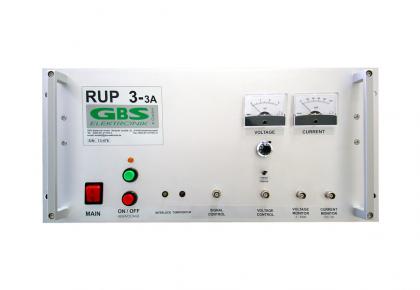
The high-voltage pulse generators of the RUP3 series consist of a high-voltage power supply with a connected semiconductor module. This topology allows completely freely selectable pulse widths and duty cycles up to 100% (DC operation). Protection against overcurrent and short circuits in the load is provided by protective resistors. For this reason, the RUP3 pulse generators are also more suitable for high-resistance loads with smaller to medium capacities. The pulse generators of the RUP3 series are very fast; Especially with devices with an output resistance of 50-100 Ohm, rise times of 50 ns are typical.
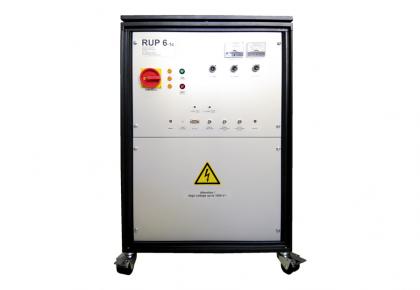
Depending on the design, the RUP6 consists of many cascaded 1kV IGBT half-bridge pulse modules which are connected in parallel for charging and connected in series for the pulse itself. This requires only a 1kV primary power supply. Modulator and power supply are inseparably integrated into one another in this principle. The pulse width is almost freely selectable and is limited only by the stored energy. The pulse generators of the RUP6 series, typically, provide negative output voltages.
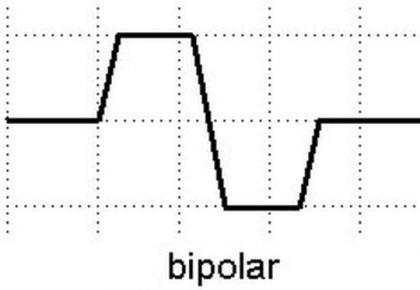
The RUP6 bipolar consists, like the normal RUP6, of many cascaded 1kV pulse modules, which are connected in parallel and connected in series for the pulse. The bipolar case include not only a half-bridge, but a full-bridge and can therefore be connected in series in both polarities.
Here too, only one 1kV primary power supply is needed. The pulse width is freely selectable within very wide limits and is limited only by the stored energy.
The sequential control of the modules is also typical for the RUP6 bipolar; thus not only the pulse width and frequency, but also the rise time can be set in a wide range.
A typical application for the RUP6 bipolar are capacitive loads or high voltage isolation tests with corresponding frequency.
The RUP6 bipolar pulse generators can selectively output positive pulses, negative pulses, or a negative pulse immediately following a positive pulse.
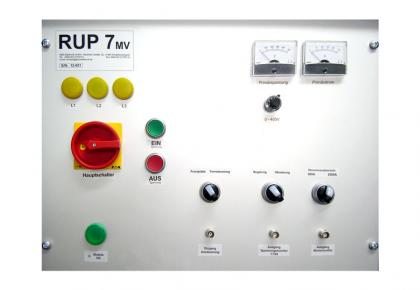
The RUP7 series includes current pulse generators that are designed for load impedances << 50Ohm and primarily for loads where the inductive component dominates. The outputs of the devices are basically potential-free and the current is switched off all-pole, so that the present energy in the load inductance is fed back into the pulse generator.
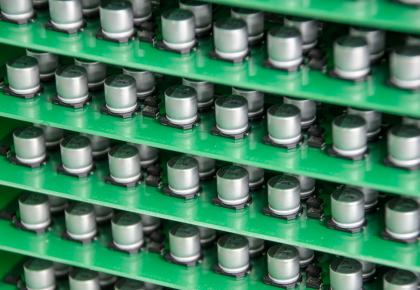
The pulse generator RUP8 is a universal high-voltage pulse generator, which achieves maximum output voltages of +15 to +90 kV, depending on the design stage. In addition to its suitability for very high voltages, the outstanding feature of the RUP8 series is the economical and compact design. Positive square pulses are generated, preferably for operation at high impedance loads with low capacitances, e.g. for electrostatic coating processes. The pulse current is up to 1A, short circuit proof.
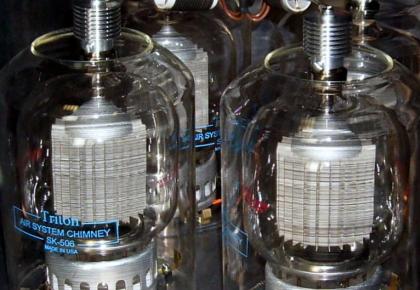
The high-voltage pulse generators of the RUP1-2 and RUP4-5 series were designed for negative pulses based on electron tubes. The tetrode is connected in parallel to the load, with a cathode-potential close to ground. The output is capacively coupled and principally potential free. A great advantage of tube topology is, that they are inherent current-limited and insensitive to short-term overloads. However, tube topology also has disadvantages. Thus, the devices are not scalable, the selection of suitable tetrodes was / is limited. During operation, x-ray radiation is generated, which must be shielded with lead. In addition an approval is neccessary.
Research Center Dresden-Rossendorf | Technical University of Berlin | University of Frankfurt | Society of Heavy Ion Research, Darmstadt | University of Augsburg | Institute for Surface Modification, Leipzig | Research Center Jülich | European Commission, Luxembourg | Institute for Reference Materials and Measurements, Geel, Belgium | Joint Research Center Ispra, Italy | Instituto Nacional de Pesquisas Espaciais, Brazil | CNEA, Argentina | National Accelerator Center, Cape Town, South Africa | Samsung, South Korea | University of Sydney, Australia

© GBS Elektronik GmbH
Copyright 2026

GBS Elektronik GmbH
Bautzner Landstraße 22
01454 Radeberg | Germany

Telefon: 0049 351 - 21 70 07 0
Telefax: 0049 351 - 21 70 07 21
