



GBS Elektronik GmbH develops and manufactures equipment with very special requirements for various applications in the area of nuclear measurement technology.
Whether radioactive contaminated rooms and objects need to be measured and monitored, signals of counter detectors processed and whose movement has to be controlled by a motor unit, or automatically restart of unattended measurements in the event of an error, we can offer you corresponding devices.
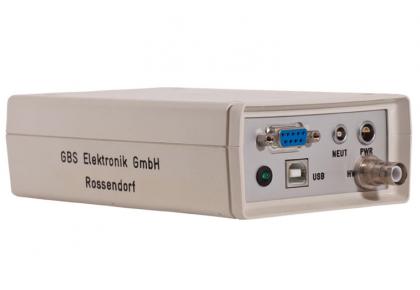
NScan is a computer controlled device that can measure signals from counter detectors (neutron counter, Geiger-Müller counter tube, etc.). The NScan has a motor control unit, which can be used to control the motion of the detector. A main application of NScan is automated verification measurements on deposits of nuclear waste. The communication and power supply is via the USB port of the computer.
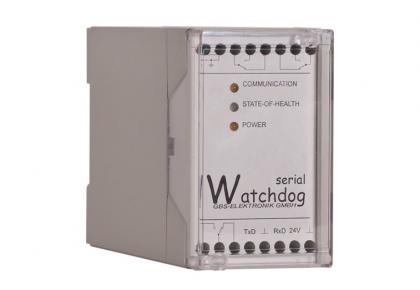
The watchdog can be used to monitor programs (e.g. WinSpec Automation) for Windows 7 / XP / 9x / NT, which perform unattended measurements or similar tasks. Prerequisites are that the program has the ability to reactivate itself after a restart of the computer and the program periodically writes a file to a specific directory. If no new file is written within the period defined by the user, then a hang up of the program or the operating system is suspected and an attempt is made to restart the computer, first software then hardware.
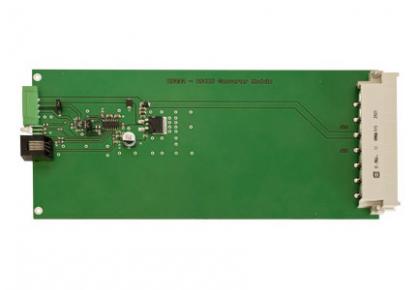
The RS232 to RS485 Converter is a customized circuit board which converts signals from a RS232 RJ11 input to RS485 Phoenix Contact 3.8 mm output signal. The latest version supports conversion is both directions via a jumper.
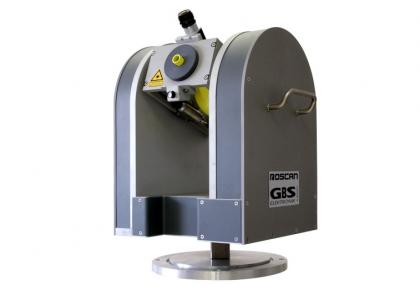
The RoScan Gamma scanner was jointly developed by the Verein für Kernverfahrenstechnik und Analytic Rossendorf e.V. (VKTA / Nuclear Engineering and Analytics Rossendorf Inc.) and GBS Elektronik GmbH to measure radio-contaminated rooms or objects. With the RoScan it is also possible to locate radioactive leaks in tanks and pipelines. The RoScan takes a picture with a digital camera and measures single gamma spectra with a collimated detector. The radiation intensity is superimposed and visualized as color information on the recorded image.
Research Center Dresden-Rossendorf | Technical University of Berlin | University of Frankfurt | Society of Heavy Ion Research, Darmstadt | University of Augsburg | Institute for Surface Modification, Leipzig | Research Center Jülich | European Commission, Luxembourg | Institute for Reference Materials and Measurements, Geel, Belgium | Joint Research Center Ispra, Italy | Instituto Nacional de Pesquisas Espaciais, Brazil | CNEA, Argentina | National Accelerator Center, Cape Town, South Africa | Samsung, South Korea | University of Sydney, Australia

© GBS Elektronik GmbH
Copyright 2026

GBS Elektronik GmbH
Bautzner Landstraße 22
01454 Radeberg | Germany

Telefon: 0049 351 - 21 70 07 0
Telefax: 0049 351 - 21 70 07 21
